

Case study: frequency support services in CHP plants with BVT Sweden
How combined heat and power and district heating plants can provide grid frequency support services with the BVT-TB turbine bypass valve.

Sweden is a good example of how the power system has changed: from steady baseload production to generation that depends more and more on the weather. This case, developed by BVT Sweden, a manufacturer we represent, shows how combined heat and power (CHP) and district heating plants can be technically prepared to provide frequency support services to the grid and turn them into a new source of revenue.
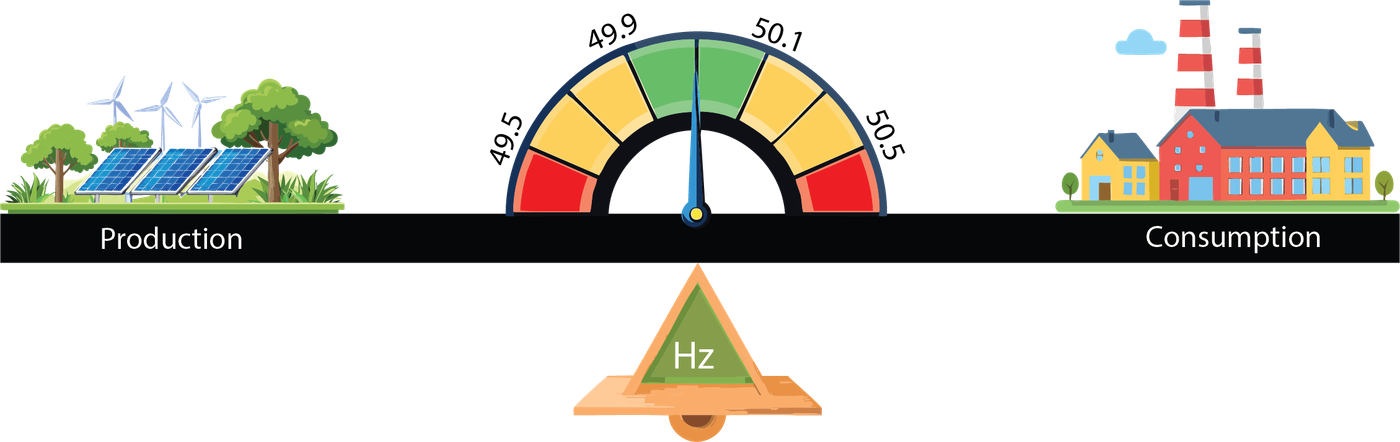
The starting point
For decades, Swedish hydroelectric plants have acted as a fast and reliable balancer keeping the grid stable at 50 Hz. With the large-scale arrival of intermittent renewables and less baseload production, the system now needs more flexibility and even shorter response times than hydropower can deliver.
What the grid operator requires
To support system stability, the Swedish transmission system operator Svenska kraftnät has introduced several support services, each with its own activation requirements:
- FFR (Fast Frequency Reserve): a remedial measure for transient frequency drops. Full activation within 1.3 s at 49.7 Hz, within 1.0 s at 49.6 Hz and within 0.7 s at 49.5 Hz.
- FCR-N: handles normal frequency variations. Automatic linear activation when the frequency deviates from 50 Hz, with full activation within 180 s for deviations of ±0.1 Hz.
- FCR-D: handles deviations during disturbed operation. Automatic linear activation between 49.9 and 49.5 Hz (upward regulation) and between 50.1 and 50.5 Hz (downward), with full activation within 30 s.
- aFRR: relieves activated FCR-N and FCR-D reserves. Automatic linear activation, with full activation within 300 s (5 minutes).
- mFRR: relieves the automatic services and is used mainly to manage disturbances and overloads on the transmission grid. Full activation within 15 minutes.
For a district heating plant able to generate electricity, taking part in these services brings significant additional revenue: the Swedish market is currently worth around SEK 3–3.5 billion and is expected to keep growing.
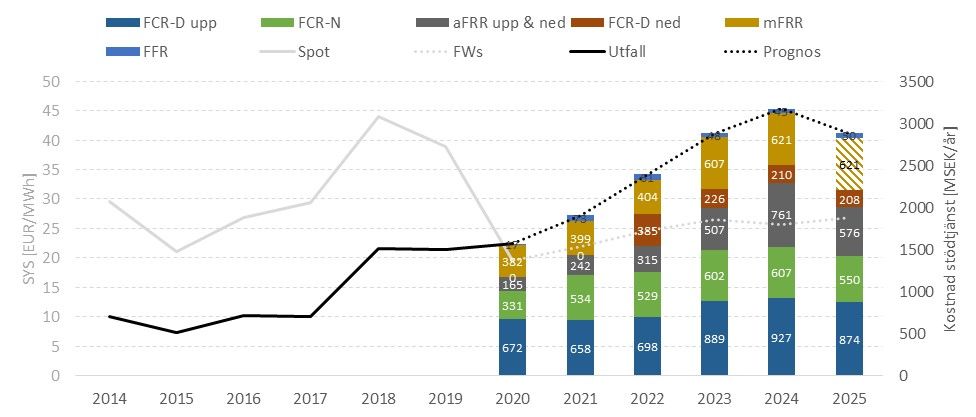
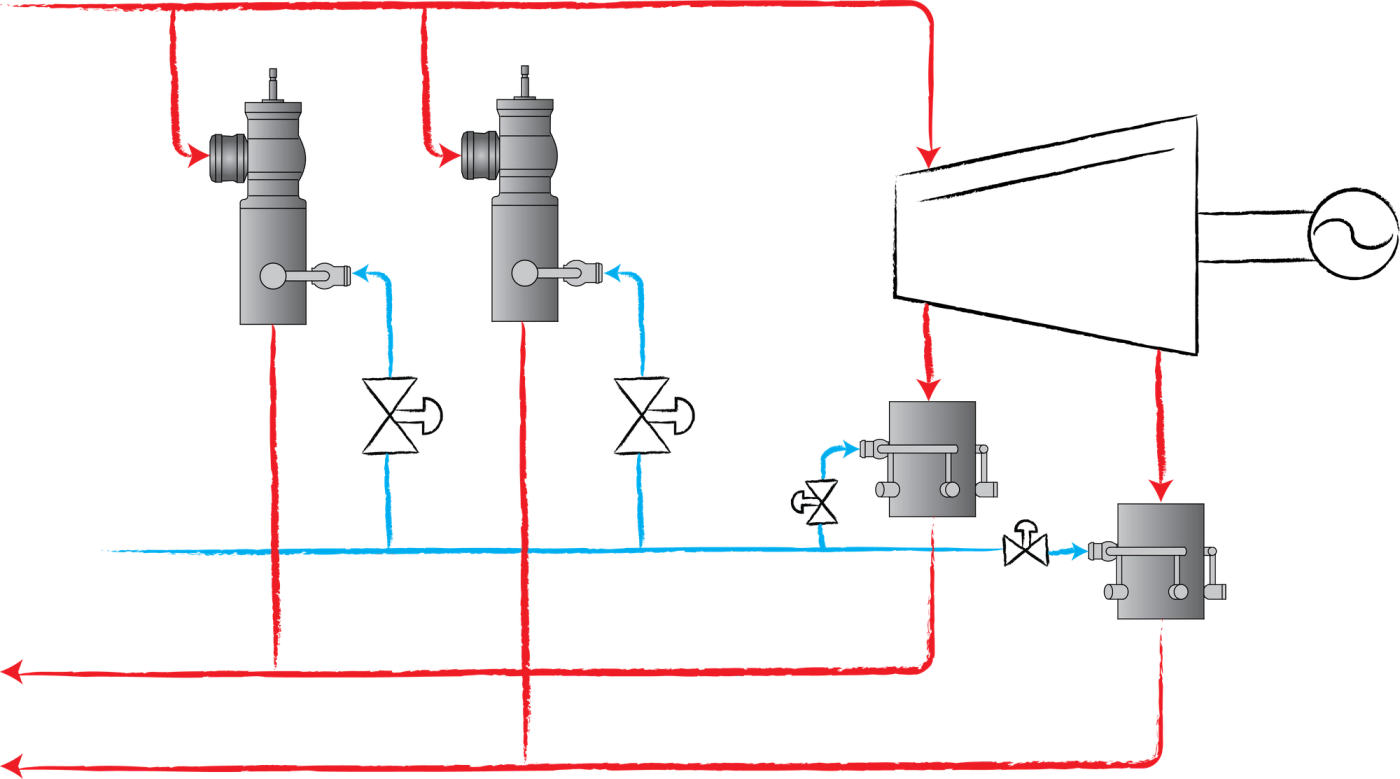
The technical solution: the turbine bypass valve
To qualify for these services, the plant must be technically prepared: power production has to start or stop within minutes. Because the energy medium is steam, every component in the steam system must cope with much greater flexibility. The most critical component is the turbine bypass valve, usually installed in parallel with the steam turbine and feeding the district heating condenser directly.
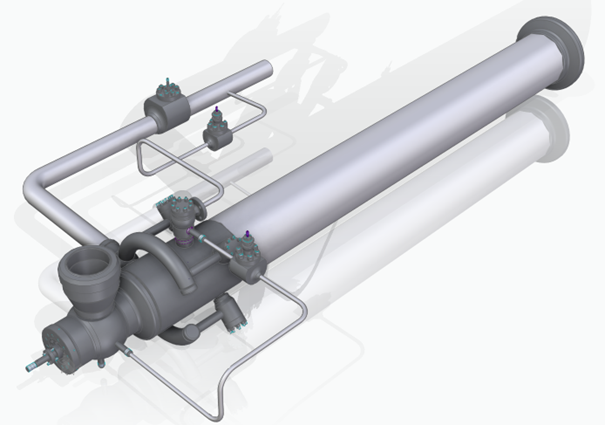
The BVT-TB steam conditioning valve, in its extended-rangeability version, is a control valve system built for the most demanding requirements on today's market:
- High rangeability thanks to a dual cooling-water injection system.
- Best low-flow performance on the market.
- Combines the advantages of spring-loaded spray nozzles and steam-assisted nozzles.
- Fully forged valve body, manufactured in Sweden.
Results
BVT Sweden's solution for temperature control at minimal flows has been successfully implemented in several district heating plants. With it, CHP plants can meet the strict technical requirements of frequency support services while maximising revenue, reducing emissions and contributing to a more stable and flexible energy supply.
What transfers to other plants
- Identify which service matches the plant's real dynamics: responding in seconds (FFR, FCR-D) is very different from responding in minutes (aFRR, mFRR).
- Review the whole steam system, not just the turbine: every component must withstand frequent starts, stops and load changes.
- Pay particular attention to the turbine bypass and desuperheating, which must control temperature accurately even at very low flows.
- Include frequency support as a revenue stream when assessing the business case for an upgrade.
About BVT Sweden
BVT Sweden, based in Säffle, develops and manufactures valves for power plants worldwide. It designs and builds complete control systems and offers turnkey solutions including installation, pipe calculations and system design. Tecnovent is its official distributor in Spain.
Frequently asked questions
What are frequency support services?
Services procured by the grid operator to keep the frequency at 50 Hz. In Sweden, Svenska kraftnät uses FFR, FCR-N, FCR-D, aFRR and mFRR, with activation times ranging from under one second to 15 minutes.
Why can a CHP plant take part in these services?
Because it can modulate its electrical output by diverting steam from the turbine to the district heating condenser, provided the steam system is prepared for rapid load changes.
Which component is the most critical?
The turbine bypass valve, installed in parallel with the steam turbine. It must respond quickly and control steam temperature accurately even at very low flows.
What does the extended-rangeability BVT-TB offer?
A dual desuperheating injection system, best-in-market low-flow control, a combination of spring-loaded and steam-assisted nozzles, and a fully forged body manufactured in Sweden.