

Pressure-vacuum valves: essential protection for atmospheric tanks
Why an atmospheric tank needs a properly sized PV valve to prevent collapse or overpressure, and how to select it per API 2000 and EN 14015.

An atmospheric tank isn't really atmospheric: it operates with overpressures and vacuums of just a few millibars, but those few millibars are the boundary between safe operation and a ruptured roof or collapsed floor. The pressure-vacuum (PV) valve is the device that holds that boundary, and its correct selection is governed by strict regulations.
What problems does a PV valve solve?
During filling, displaced vapours must escape; if they find no outlet, internal pressure rises and may deform the roof. During emptying or in the event of sudden cooling, air must enter; if it does not, a vacuum forms and the tank can collapse like a crushed can. A PV valve handles both directions with independent set points.
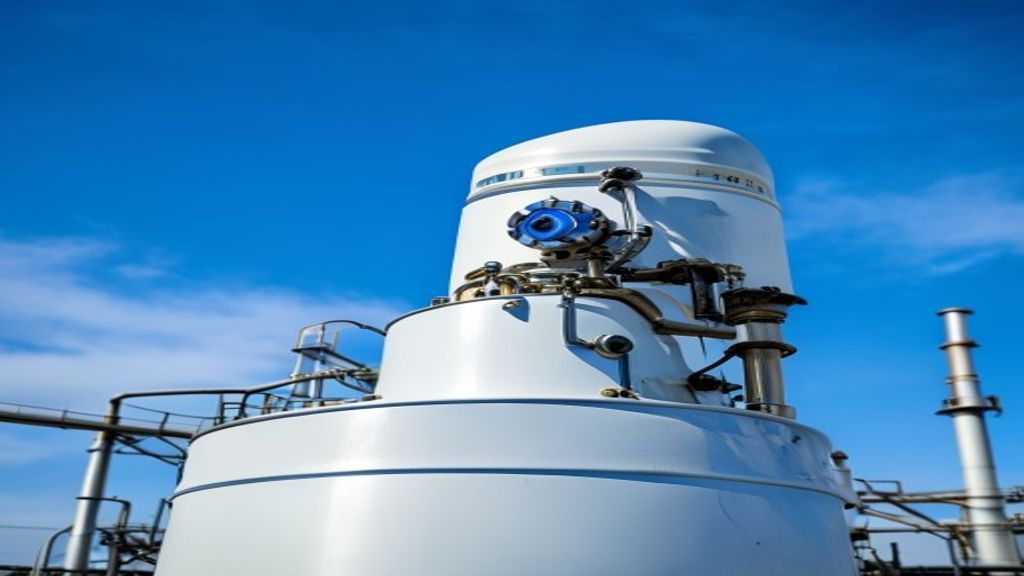
Difference from a safety relief valve
Although they look similar, the PV valve works in very low pressure ranges (typically ±25 mbar) and must be tight under normal operation to minimise VOC emissions. A conventional safety valve (PSV) is not leak-tight at low pressure and would continuously waste product to the atmosphere.
Sizing according to API 2000
The sixth edition of API 2000 sets minimum venting flow rates based on:
- Product movements (in-breathing during emptying, out-breathing during filling).
- Thermal variation (night-time in-breathing from cooling, daytime out-breathing).
- Emergency scenarios: external fire, blanketing system failure, internal coil rupture.
For new tanks, EN 14015 also requires documenting the critical scenario and providing traceability for the calculation. In both codes, the fire case is almost always the governing scenario.
Pilot-operated vs. weight-and-pallet
Direct weight-loaded PV valves are simple, robust and economical, but their opening pressure follows an exponential curve: the last 10% of flow requires very high overpressure. Pilot-operated PV valves hold the set point up to 100% of flow and drastically reduce fugitive emissions in normal operation. The choice depends on the balance between capital cost and operating cost (losses + environmental compliance).
On large-capacity tanks with volatile products, a pilot-operated PV valve pays back its premium in less than two years thanks to the reduction in VOC emissions.
Maintenance recommendations
- Monthly visual inspection of the seat and pallet to detect dirt or crystallisation.
- Annual bench set-point testing per API STD 2000 §7.
- Replacement of the elastomeric seal every 3-5 years depending on the product.
- Replacement of the integrated flame arrestor, if part of the assembly, based on accumulated service hours.
Conclusion
The PV valve is the most underrated piece of equipment in a tank farm. Its failure does not produce a dramatic incident until the right combination of conditions occurs - and then it is catastrophic. Investing in a properly sized and maintained PV valve is the most profitable decision a plant manager can make.